

Heavy Duty Rolling Tool Storage: 2026 Review

Table of Contents
- Heavy Duty Rolling Tool Storage: What Actually Matters
- Quick Comparison: Pro Series Rolling Tool Storage at a Glance
- How We Evaluated These Rolling Tool Cabinets
- Why an 18-Gauge Steel Tool Cabinet Outlasts Thinner Boxes
- Drawer Capacity, Slides, and Load Distribution
- Casters, Mobility, and Locking Systems
- How to Organize a Small Garage Around Rolling Tool Storage
- Which Pro Series Rolling Tool Storage Fits Your Shop?
- Frequently Asked Questions
Last Updated: October 13, 2026
Heavy Duty Rolling Tool Storage: What Actually Matters
Heavy duty rolling tool storage is a mobile steel cabinet built to carry serious tool weight on casters, roll it across a workshop floor, and lock it down at day's end. At Garage Mosaic, we build ours from 18-gauge steel with 100 lb. drawer slides and 2,200 lb. caster sets, because those three specs decide whether a box lasts a decade or a year.

Most buying guides list drawer counts and stop there. That is backwards: a 14-drawer box with thin steel and weak slides is worse than a 5-drawer box built properly.
Below, we rank our Pro Series lineup side by side and explain the specs that predict long-term performance: steel gauge, slide rating, load distribution, caster quality, and locking.
Quick Comparison: Pro Series Rolling Tool Storage at a Glance
The right cabinet depends on your footprint, tool volume, and whether you need a work surface. Here is how the Pro Series line compares.
| Model | Width | Drawers | Price | Best For |
|---|---|---|---|---|
| 35" 3-Drawer Slide-Top Service Cart | 35" | 3 | $1,000 | Tight garages, mobile jobs |
| 45" 11-Drawer Rolling Tool Box + Tool Set | 45" | 11 | $2,600 | Home mechanics starting out |
| 45" 12-Drawer Workstation | 45" | 12 | $2,700 | Four-sided shop access |
| 53" 20-Drawer Rolling Tool Box | 53" | 20 | $3,400 | Growing tool collections |
| 72" 14-Drawer Rolling Tool Box | 72" | 14 | $4,200 | Professional daily use |
| 72" 14-Drawer with Garage Top | 72" | 14 | $5,685 | Full workstation setups |
Cabinet size runs in 2-foot, 4-foot, and 6-foot classes.

A table alone does not tell you which box fits your shop. Narrow by size and budget above, then compare any two models on steel gauge, slide rating, caster capacity, and lock type.
How to read this comparison
Start with floor space. Measure the wall where the cabinet will live, then allow 24 inches of clearance in front of every drawer bank.
Next, count tools by volume, not drawer count. A 20-drawer box with shallow drawers holds less than a 14-drawer box with deep drawers.
Then check the three durability specs that separate heavy duty from light duty:
- Steel gauge: 18-gauge or thicker. Lower numbers mean thicker steel. Our Pro Series boxes use 18-gauge throughout.
- Slide rating: 100 lbs. per slide minimum. Deep drawers on the 72" boxes use double 100 lb. slides.
- Caster capacity: Total capacity should exceed the loaded weight of the cabinet by at least 30%. Our 2,200 lb. caster sets handle the heaviest Pro Series loads.
Finally, match the lock to your risk.
How We Evaluated These Rolling Tool Cabinets
We scored each Pro Series model on five criteria, weighted toward what fails first in a real shop: steel gauge and construction, slide rating and load capacity, caster quality and mobility, locking and security, and long-term ownership cost.
Steel gauge carries the most weight: a rolling tool cabinet is a structural object, and its gauge decides how it behaves under load.

Caster capacity and locking rounded out the scoring. A cabinet that rolls badly or locks weakly fails the two jobs a mobile box exists to do.
We also factored warranty coverage into every score. Our Pro Series boxes carry a lifetime warranty, which changes the ownership math considerably.
Why an 18-Gauge Steel Tool Cabinet Outlasts Thinner Boxes
An 18-gauge steel tool cabinet resists denting, drawer sag, and racking far better than thinner 20- or 22-gauge boxes, which is why we build every Pro Series unit from it.
That difference shows up in three places.
First, drawer bottoms. A thin bottom bows under a full socket set; a thicker one holds its shape, keeping slides aligned and the drawer closing smoothly.
Second, the frame. Box and beam construction with gusset-reinforced corners keeps the box square so drawers do not bind on uneven floors. Every Pro Series box uses spot-welded assembly with full-length beam supports.
Third, the finish. Powder coat applied inside and out resists the humidity that rusts cheap boxes from the inside out.
Drawer Capacity, Slides, and Load Distribution
Drawer capacity is set by the slide, not the drawer. Our full-extension slides are rated at 100 lbs. per slide, and the deeper drawers on the 72" boxes use double 100 lb. slides to handle heavier loads without flexing.
Load distribution matters as much as total capacity. Heavy items belong low and centered, because weight up high raises the center of gravity and makes the box less stable with a drawer open.
A few practical rules we give customers:
- Put impact sockets, hammers, and large wrenches in the bottom drawers
- Keep frequently used hand tools in the mid-height drawers at waist level
- Reserve shallow top drawers for precision tools and small parts
- Use EVA foam inserts so tools stay put when the cabinet rolls
Full-extension slides let you reach the back of a deep drawer without pulling the box forward, keeping weight over the casters where it belongs.
Casters, Mobility, and Locking Systems
Casters decide whether a loaded cabinet moves easily or fights you.
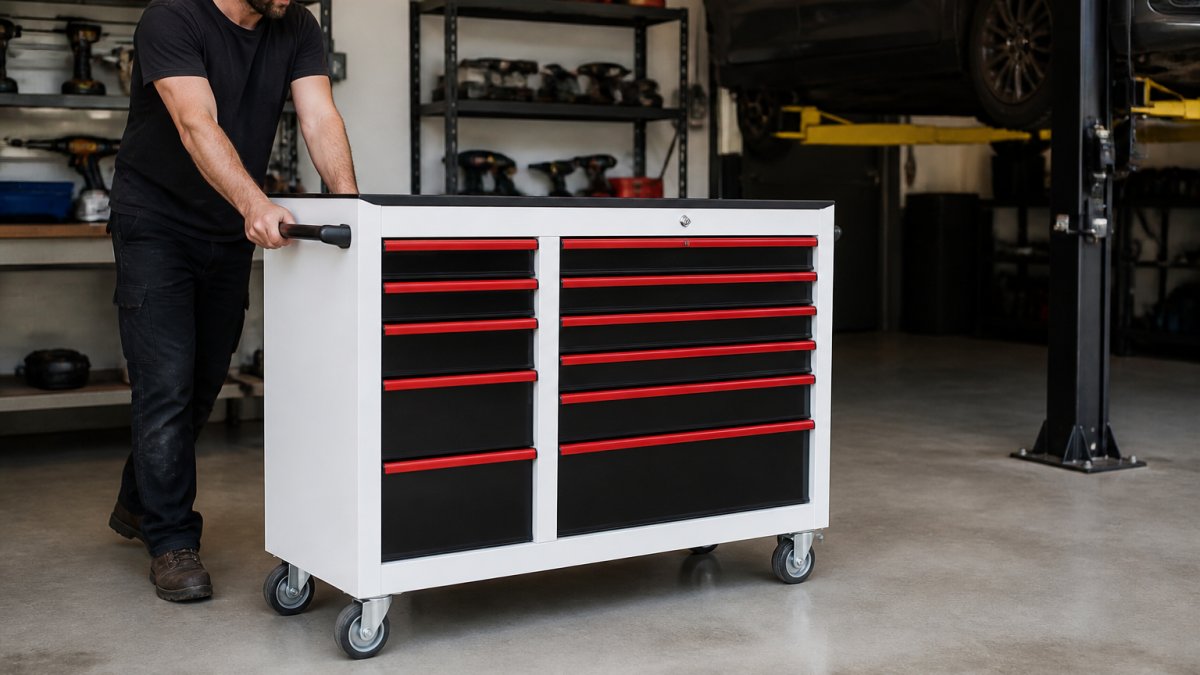
Floor surface changes caster performance more than most buyers expect. Smooth sealed concrete rolls well with any wheel.
Wheel diameter is only one variable. Wheel material, bearing type, and brake design matter just as much.
Pro Series | 72" 14-Drawer Rolling Tool Box →
Wheel material and floor compatibility
- Hard nylon or polyurethane: Rolls easily on smooth concrete and resists flat-spotting under heavy loads. Can mark soft flooring and transmits vibration on uneven surfaces.
- Rubber or thermoplastic rubber: Quieter and grips better on epoxy and tile. Wears faster under constant heavy loads and can leave marks on light-colored floors.
- Steel or cast iron: Extremely durable and rolls well on rough concrete. Noisy, can rust in humid garages, and will damage epoxy coatings.
Most heavy duty rolling tool storage uses polyurethane or nylon wheels because they balance load capacity, rolling resistance, and floor protection.
Bearing type
Caster bearings affect how easily a loaded box starts rolling.
Braking and swivel behavior
Locking swivel casters hold the box still on a slope, but not all locks work the same way.
Swivel behavior matters in tight spaces.
How to test casters before you buy
- Load the box to at least half its rated capacity and roll it across the same floor surface you will use.
- Roll over a threshold or floor seam to see if the wheels catch or climb.
- Engage the brakes and try to push the box sideways. If it moves, the brakes are not total-lock.
- Check that the casters are bolted, not welded, so you can replace them if they wear out.
Locking systems
Locking systems protect the investment.
Barrel locks are simple and reliable; digit locks add convenience if multiple people use the box.
Mobility details worth checking before you buy:
- Handle position (ours mount left or right)
- Locking swivel casters that hold the box still on a slope
- Weight of the empty box (a 72" unit is heavy even before tools)
- Replacement caster availability and cost
How to Organize a Small Garage Around Rolling Tool Storage
Organizing a small garage starts with one decision: pick a single wall for storage and keep the floor clear for the car. A rolling cabinet makes that possible because it moves out of the way when you need the space back.
The sequence we recommend:
- Measure your wall and your car's door swing before choosing cabinet size
- Place the largest cabinet against the back wall, not the side wall
- Keep at least 24" of clearance in front of every drawer bank
- Group tools by job, not by type, so one drawer serves one task
- Roll the cabinet to the work area instead of walking back and forth
A 2-foot cabinet such as the 35" service cart fits a single-car garage without blocking the door. A 4-foot box works in a two-car garage along one wall.
Height matters too. A cabinet with a stainless steel worktop doubles as a bench, removing the need for a separate work table and freeing floor space. The 45" workstation adds four-sided access and a square-hole perforated panel for hanging accessories.
Which Pro Series Rolling Tool Storage Fits Your Shop?
Match the cabinet to your space and tool volume, not the biggest number on the spec sheet.
For growing collections: the 53" 20-Drawer Rolling Tool Box at $3,400 splits into a top chest and bottom cabinet, with anti-tip technology and a digit-lock option.
For a full workstation: the 72" 14-Drawer with Garage Top at $5,685 adds a reinforced top with gas struts and a full-width accessory panel.
Every Pro Series box carries a lifetime warranty. For more on how gauge and construction affect lifespan, see OSHA guidance on hand and power tool safety and ANSI standards for storage and work equipment.
Frequently Asked Questions
What should I look for in a heavy duty rolling tool cabinet?
Start with steel gauge: 18-gauge construction resists warping far better than thinner sheet metal. Check drawer slides next, since 100-pound rated steel ball bearing slides with double slides on deep drawers handle heavy sockets without sagging. Then look at caster capacity, which should exceed the fully loaded weight of the box. Locking matters too, and a key lock plus digit-lock combination covers both daily use and theft deterrence. Finally, confirm drawer dimensions match your tool layout before buying.
Are 18-gauge steel tool cabinets better than thinner alternatives?
Yes, for anything beyond light home use. An 18-gauge steel tool cabinet holds its shape when drawers are loaded with wrenches, impact sockets, and power tools, and it resists the flexing that causes drawers to bind. Thinner steel dents at the corners and along drawer banks, which throws slides out of alignment. Gusset-reinforced corners and box beam construction add further rigidity. In a humid garage, powder coat over 18-gauge steel also resists rust better than painted thin panels.
How much weight can a heavy duty rolling tool chest hold?
It depends on the drawer, not just the box. The Pro Series line rates each drawer slide at 100 pounds, with double 100-pound slides on deeper drawers, so a wide drawer can carry 200 pounds. Caster capacity is the second limit: Pro Series casters are rated for a total of 2,200 pounds across the unit. Add the cabinet's own weight, such as 507 pounds for the 53-inch combo, and you get a realistic ceiling for what you can load and still roll it safely.
What are the benefits of mobile rolling tool storage in a small garage?
Mobility turns one footprint into several work zones. A 45-inch workstation on locking casters can sit against the wall while parked, then roll to the vehicle when you need it. That matters in a small garage where a fixed bench would block access. Look for two fixed and two locking swivel casters, plus a side handle you can mount left or right. Locking swivels keep the unit stationary during heavy pulling, and the handle gives you control on uneven slabs.
How do I maintain the casters on my rolling tool storage?
Keep the floor clear of grit, since debris is the main cause of flat spots and rough rolling. Wipe caster wheels and fork assemblies periodically, and clear hair or wire strands wrapped around the axle. Check that locking swivel casters still engage firmly; a worn brake lets the box creep when you pull a loaded drawer. If a caster develops a flat spot from a long stay in one position, rotate the unit so weight shifts to other wheels. Inspect mounting bolts yearly.
Choosing heavy duty rolling tool storage comes down to matching steel gauge, slide rating, and caster capacity to the way you actually work. Get those three right and the cabinet outlasts the tools inside it.
At Garage Mosaic, we build every Pro Series box from 18-gauge steel with 100 lb. slides, 2,200 lb. caster sets, and a lifetime warranty, so your storage keeps up with your garage for years. Shop today and build a setup designed for real, everyday use.