

Essential Tools for Home Car Maintenance: 2026 Guide

Table of Contents
- Essential Tools for Home Car Maintenance: What You Actually Need
- Building a Basic Mechanic Tool Set Without Overspending
- DIY Car Maintenance Tools for Every Skill Level
- Lifting, Supporting, and Tire Tools You Should Never Skip
- Digital Diagnostic Integration: OBD-II Scanners and Measuring Tools
- A Car Maintenance Checklist You Can Follow Every Season
- Garage Tools for Vintage Cars: Protecting Older Vehicles
- Tool Maintenance, Calibration, and Storage That Lasts
- Frequently Asked Questions
Last Updated: October 13, 2026
Essential Tools for Home Car Maintenance: What You Actually Need
The best money you spend on your car isn't at the dealership. It's on a torque wrench, a hydraulic jack, and a decent socket set. This guide from Garage Mosaic breaks down the essential tools for home car maintenance by job, not by brand loyalty, so you buy what actually gets used.
Start With the Job, Not the Tool List
Most tool lists fail because they start with the tool and work backward. That's backwards. A basic mechanic tool set should be built around the four jobs you'll actually do: oil changes, tire rotation, brake inspection, and battery service. Buy for those jobs first, and expand as your confidence grows.

Building a Basic Mechanic Tool Set Without Overspending
A 159-piece metric and SAE combo set covers roughly 90% of routine work on a modern car. Spend there first, not on a wall of single-purpose gadgets.

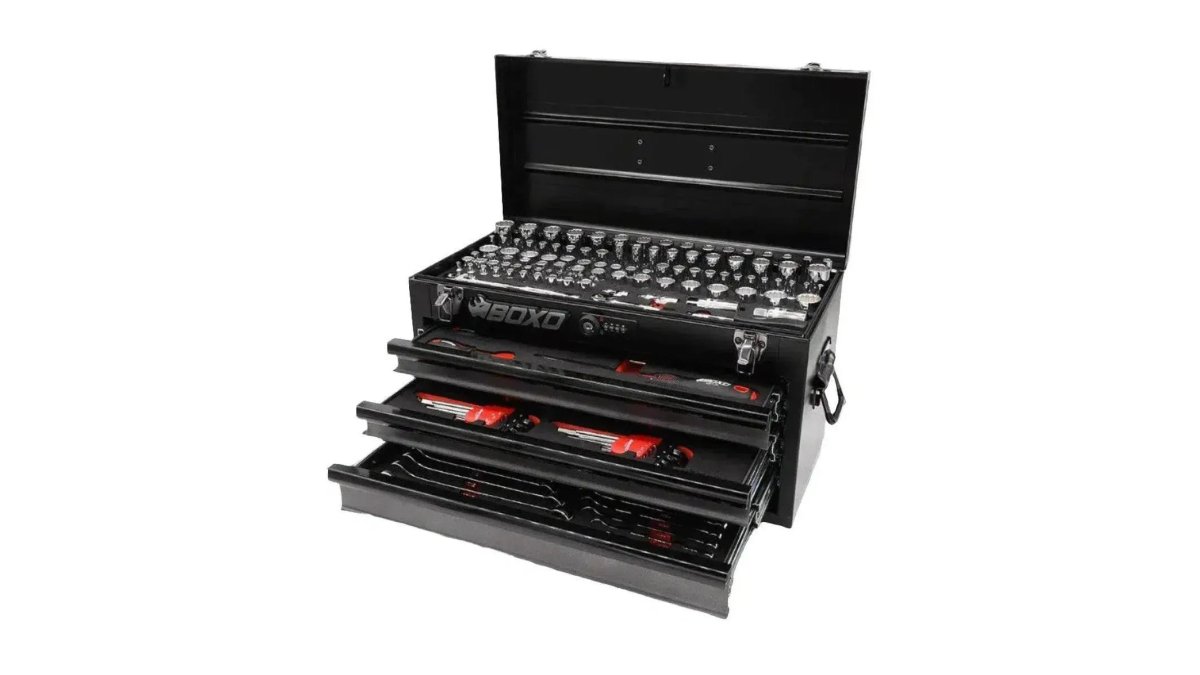
Metric or SAE: Match the Set to the Vehicle
Metric fits most vehicles built outside North America; SAE fits many domestic models. If you own both, a combo set saves you from buying twice. The 159-Piece Metric and SAE Combo 3-Drawer Hand Carry Tool Box covers both fastener standards with 1/4" and 3/8" drive 90-tooth ratchets, deep sockets, and combination wrenches with 15° offset box ends.
What a Starter Set Should Contain
- 1/4" and 3/8" drive ratchets with extensions
- Standard and deep sockets in both standards
- Combination wrenches, screwdrivers, and pliers
For domestic vehicles only, the 117-Piece SAE 3-Drawer Hand Carry Tool Box packages the same professional-grade layout in SAE sizes.

DIY Car Maintenance Tools for Every Skill Level
The gap between a beginner kit and a professional setup isn't tool count. It's organization and durability.
Budget vs. Professional Grade: Where the Money Goes
Budget tools cut corners on steel grade, ratchet tooth count, and finish. For a serious home setup, the Metric and SAE Master Tool Set | Starter, 222-Pieces offers a complete foundation with three EVA foam drawer inserts. For technicians handling heavier jobs, the Metric and SAE Master Tool Set | Advanced, 379-Pieces adds ½" drive impact sockets and a hammer set.
Lifting, Supporting, and Tire Tools You Should Never Skip
Lifting and supporting a car is the one area where a cheap tool can kill you. Competitors list a jack and stands; the depth that matters is understanding what each tool actually does, how it fails, and how to match it to your vehicle.
Jacks: Floor Jack vs. Scissor vs. Bottle
A hydraulic floor jack is the home-garage standard because it lifts quickly and rolls under low cars. Scissor jacks that ship with the car are emergency-only, they are unstable on anything but perfectly flat pavement and have a narrow lift range. Bottle jacks are compact and high-capacity but have a small saddle that can slip off a pinch weld.
Jack Stands: Rating, Base, and Placement
Never work under a car held only by a jack. A hydraulic jack lifts; jack stands hold. Match the stand's rated capacity to your vehicle's weight with margin, a 6-ton pair is appropriate for trucks, SUVs, and full-size vehicles, while a 3-ton pair covers most sedans and crossovers. Look for a wide, low-set base and a locking pawl that engages the stand's notched post.
Torque Wrenches: The Tool That Prevents Expensive Mistakes
A torque wrench is the single most underrated tool in a home garage. Under-torquing a wheel can let lug nuts back off; over-torquing stretches studs, warps brake rotors, and strips threads in aluminum heads. Click-type wrenches are the most common for home use, you set the value, and the wrench clicks when you reach it.
Tire Maintenance Tools: Pressure, Tread, and Rotation
- Tire pressure gauge. A quality dial or digital gauge beats the stick gauge in your glovebox. Check pressure cold, before driving, and compare against the door-jamb placard, not the tire sidewall max.
- Tread depth gauge. Legal minimum is 2/32", but wet-weather traction drops noticeably below 4/32". A gauge gives you a number; the penny test only gives you a guess.
- Wheel chocks. Cheap insurance against a car rolling while you work.
A common pattern is to rotate tires every 5,000-7,500 miles, or at every other oil change, to even out wear between front and rear. Pair the rotation with a pressure check and a quick tread measurement, and you catch alignment or suspension problems before they eat a set of tires.
| Tool | Job It Does | Why It Matters |
|---|---|---|
| Hydraulic floor jack | Lifts the vehicle | Never supports weight alone |
| Jack stands | Holds the vehicle | Rated for the load, stable base |
| Wheel chocks | Blocks rolling | Prevents movement on inclines |
| Torque wrench | Tightens to spec | Prevents stripped threads and warped rotors |
| Tire pressure gauge | Checks PSI | Affects wear, handling, and fuel economy |
| Tread depth gauge | Measures remaining tread | Tells you when wet grip is compromised |
The Orange Steel 6-Ton Jack Stand is rated for trucks, SUVs, and full-size vehicles, with a wide low-set base and powder-coated finish that resists rust.
Digital Diagnostic Integration: OBD-II Scanners and Measuring Tools
Most home-maintenance tool lists stop at wrenches and sockets. That was fine for a 1995 Civic. On any car built after 1996, the OBD-II port is where diagnosis actually starts, and a scanner is the highest-value tool you can add to a home garage after a socket set.
Metric and SAE Master Tool Set | Starter, 222-Pieces →
What an OBD-II Scanner Actually Does
Every car sold in the U.S. since 1996 has a standardized 16-pin OBD-II port, usually under the dash near the steering column. A scanner plugs in and reads the diagnostic trouble codes (DTCs) the engine computer has stored. Those codes are a starting point, not a diagnosis, a P0301 code means "cylinder 1 misfire," not "replace the coil." The scanner tells you which system to investigate; your eyes, ears, and a multimeter tell you what is actually wrong.
Scanner Tiers: Code Reader vs. Live-Data vs. Bidirectional
- Basic code reader. Reads and clears codes. Cheap, useful, and enough for checking a check-engine light before a smog test.
- Live-data scanner. Streams sensor values, coolant temperature, O2 sensor voltage, fuel trims, MAF readings, while the engine runs. This is where real diagnosis happens, because you can watch a sensor misbehave in real time.
- Bidirectional scanner. Can command actuators (run the fuel pump, cycle ABS solenoids, relearn a throttle body). This is the tier that pays for itself if you plan to do your own brakes, batteries, or electronic parking-brake service.
A common pattern is to start with a live-data scanner and upgrade to bidirectional only when a specific job requires it. Many modern vehicles also need a scanner to reset the oil-life monitor or put the electronic parking brake into service mode before a brake job.
Pairing the Scanner With Measuring Tools
A scanner narrows the system; measuring tools confirm the fault.
- Digital multimeter. Essential for chasing electrical faults, parasitic draws, bad grounds, open circuits, and sensor reference voltages. A basic auto-ranging meter with a 10-amp DC current setting covers most home work.
- Feeler gauge set. For spark plug gaps on older engines and for checking valve clearances on engines that still use shims.
- Infrared thermometer. Confirms brake caliper drag, radiator inlet/outlet temperature spread, and catalytic converter efficiency without pulling parts.
A Realistic Diagnostic Workflow
- Scan for codes and freeze-frame data.
- Note the conditions when the fault set (cold start, highway speed, after refueling).
- Check live data against expected values for the sensor in question.
- Confirm with a multimeter at the connector before replacing anything.
- Clear the code and re-scan after a drive cycle to confirm the fix.
The Pro Series 28" cart includes a tire tread gauge, tire pressure gauge, and feeler gauge set, so measuring tools travel with the job, but the scanner is the tool that turns guesswork into a plan.
A Car Maintenance Checklist You Can Follow Every Season
A seasonal car maintenance checklist keeps small problems from becoming expensive ones.
- Check tire pressure and tread depth
- Inspect brake pads and rotors
- Test battery voltage and terminals
- Check all fluid levels and top off
- Replace wiper blades if streaking
- Scan for fault codes with an OBD-II reader
Garage Tools for Vintage Cars: Protecting Older Vehicles
Vintage vehicles need gentler handling than daily drivers. Older fasteners seize, so penetrating oil and a breaker bar beat brute force. Store tools and spare parts in sealed, organized cabinets to control humidity, and keep the floor coated to reduce dust and moisture. The Duraamen Perdure PU85 Polyurea Polyaspartic Coating bonds directly to concrete, resists impact and chemical spills, and stays UV-stable without fading.
Tool Maintenance, Calibration, and Storage That Lasts
Tools that last are tools that get maintained. Wipe chrome sockets after use, oil ratchet mechanisms yearly, and store everything in foam trays so nothing shifts or rusts. For a growing collection, the Pro Series 72" 14-Drawer Rolling Tool Box uses 18-gauge steel, full-extension ball-bearing slides rated at 100 lbs., and integrated power strips for charging tools in place.
Frequently Asked Questions
What basic tools should every home mechanic have?
Start with a ratchet and socket set in both metric and SAE, a set of combination wrenches, screwdrivers, pliers, and hex keys. Add a torque wrench, breaker bar, jack, jack stands, wheel chocks, and a tire pressure gauge for safety-critical jobs. A 222-piece set like the Metric and SAE Master Tool Set covers most of this in one purchase, which is cheaper and better organized than buying individual pieces.
Which tools do I need for routine car maintenance?
Routine work like oil changes, tire rotation, and brake inspection needs a socket set, oil filter wrench, funnel, drain pan, torque wrench, and a jack with stands. Add an OBD-II scanner to read warning lights before they become repairs. A car maintenance checklist keeps these jobs on schedule: oil every 5,000 to 7,500 miles, tire rotation every 5,000 miles, and brake inspection once a year.
What safety equipment should I use when working on a car?
Safety glasses and nitrile gloves are the minimum for any job under a vehicle. Add wheel chocks before lifting, and always support the car on rated jack stands, never on the jack alone. A 6-ton stand handles trucks and SUVs with margin. Work on a level, sealed floor, and keep a work light or headlamp so you are not working blind in shadow.
How should I store tools and protect a vintage car in a home garage?
Humidity is the enemy of both tools and vintage paint. Store tools in a rolling cabinet with a powder-coated finish and EVA foam trays so nothing shifts or rusts, and keep the cabinet locked. For the car itself, a coated, UV-stable floor such as a polyaspartic coating cuts dust and moisture, and consistent lighting and ventilation prevent the condensation that leads to surface rust on chrome and body panels.
Do I need both metric and SAE tools for DIY car maintenance?
Yes, unless you only ever work on one vehicle and know its fastener standard. Domestic vehicles made before the 1980s are typically SAE, most modern cars are metric, and vintage collections often mix both. A combo set with metric and SAE sockets, wrenches, and hex keys avoids the situation where a single missing size stops the job halfway through.
Building a garage that supports real work takes more than a shopping list. Garage Mosaic builds heavy-duty 18-gauge steel tool storage, rolling cabinets, and ALI-certified car lifts designed for enthusiasts, collectors, and professional mechanics alike. Shop today and turn your garage into a space built for the work you love.