

Best Heavy Duty Garage Storage: 2026 Buyer's Guide

Table of Contents
- What to Look for in Heavy Duty Garage Storage
- Best Heavy Duty Garage Storage Systems at a Glance
- Heavy Duty Garage Shelving and Steel Garage Cabinets Compared
- Overhead Garage Storage and Vertical Space Planning
- What Does Garage Storage Cost in 2026?
- Safety, Anchoring and Installation
- Which Heavy Duty Garage Storage Should You Choose?
- Frequently Asked Questions
Last Updated: October 21, 2026
What to Look for in Heavy Duty Garage Storage
Garage Mosaic helps automotive enthusiasts, collectors, and home mechanics build garages that hold up to daily use.
Most buyers get this wrong: they buy on drawer count and color, then discover shelves sag under a loaded toolbox or the coating blisters after one humid summer.
Weight Capacity and Load Ratings
Weight capacity is the maximum load a shelf, drawer, or desktop is rated to hold, and it should be stated per component, not just for the whole unit.
Load rating matters more than total capacity. A single deep drawer holding sockets and wrenches will fail long before a uniform spread of weight does. Look for full-extension ball bearing slides and double slides on large drawers, those carry the load.
Material, Finish and Garage Conditions
Garages are hostile environments. Temperature swings, humidity, road salt, and dust attack every surface, and thin-gauge steel loses that fight quickly. Look for cold-rolled or 18-gauge steel, all-welded construction where possible, and a powder coat finish.
Bolted flat-pack cabinets loosen at the joints over time; welded steel holds its geometry. In a humid climate, a rust-resistant powder coat is the difference between a decade of service and failure in two years.
Best Heavy Duty Garage Storage Systems at a Glance
Here are the Garage Mosaic systems we recommend most often, matched to the buyer they suit. The table gives headline specs; the notes below explain the trade-offs the numbers alone do not show.
| System | Price | Key Spec | Best For |
|---|---|---|---|
| 6ft Mobile Workbench, 10 Drawers | $1,599 | 880 lbs desktop, 33 lbs per drawer | Small garages needing mobility |
| 7ft Workbench Cabinet, 20 Drawers | $2,299 | 110 lbs per drawer | Home mechanics with a growing tool set |
| 10ft Workbench, 25 Drawers | $2,899 | 1,653 lbs desktop, 110 lbs per drawer | Large shops and pro mechanics |
| 10ft Cabinet, 40 Drawers + Pegboard | $4,299 | 1,653 lbs desktop, 40 drawers | Maximum storage in one wall |
| Pro Series 72" Rolling Tool Box | $5,885 | 18-gauge steel, 100 lbs slides | Serious enthusiasts and pros |
| Fortress 30.3" Freestanding Cabinet | $579 | 4 shelves, wall brackets included | Budget-friendly vertical storage |
What the Specs Actually Mean
A 1,653 lbs desktop capacity is a static, evenly distributed rating for the work surface only.

The 6ft Mobile Workbench at $1,599 carries 880 lbs on the desktop but only 33 lbs per drawer, a mobility-first design for light tools.
The 10ft Cabinet with 40 Drawers and Pegboard at $4,299 is the maximum-storage play: same 1,653 lbs desktop, 40 drawers instead of 25, plus pegboard for visible tools.
How to Compare Beyond the Table
Three specs separate a heavy duty system from a heavy-looking one: per-drawer load rating on full-extension ball bearing slides (double slides on deep drawers); steel gauge and construction (cold-rolled or 18-gauge steel, all-welded where possible, powder coat finish); and anchoring hardware, tall units should ship with wall brackets, and freestanding cabinets should be anchored to studs regardless of the box.
Total cost of ownership matters more than sticker price. Factor in anchoring hardware, drawer liners, wall reinforcement, and delivery unloading before you compare. A cheap cabinet that warps in two years costs more than a welded steel unit that lasts fifteen. The question is how much capacity your actual tool collection needs.
Heavy Duty Garage Shelving and Steel Garage Cabinets Compared
Steel garage cabinets and heavy duty garage shelving solve different problems, and the right answer usually involves both: freestanding cabinets hide clutter, workbench cabinets combine a work surface with tool storage, and rolling units move to the job.
Freestanding Steel Garage Cabinets
The Fortress 30.3" is our pick for buyers who need closed storage without a full wall build-out. It stands 74.8 inches tall with three adjustable shelves and one fixed shelf, ships with wall brackets, and at $579 is an affordable entry into steel garage cabinets we offer.
Where it falls short: home assembly is required, and it holds shelves rather than drawers, so small loose tools need bins. For seasonal items, chemicals, and bulky equipment, that trade-off is fine.
Workbench Cabinets with Drawers
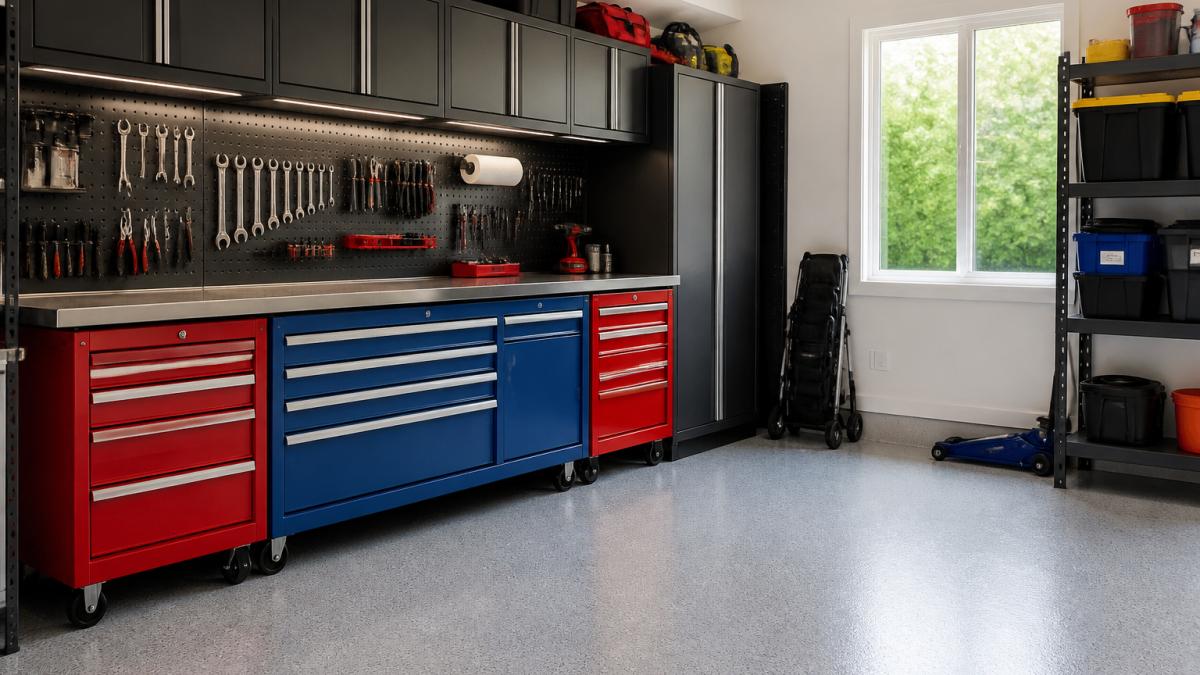
This is where heavy duty garage storage earns its name. Our 7ft Workbench Cabinet with 20 Drawers runs $2,299 and carries 110 lbs per drawer on three-rail ball bearing slides; every drawer locks and ships with anti-slip liners. The 10ft version with 25 drawers ($2,899) pushes desktop capacity to 1,653 lbs, enough for an engine block or a vise and a project at once.

Rolling Tool Storage
For mechanics who move between bays, the Pro Series 72" 14-Drawer Rolling Tool Box with a 222-piece master tool set ($5,885) is the professional-grade option: 18-gauge steel, 100 lbs ball bearing slides, double slides on deeper drawers, two 110V power strips with USB, a lifetime warranty, and four heavy-duty casters.
The honest limitation: it is a rolling box, not a wall of storage. If your garage is stationary and your tool count is high, a fixed 10ft cabinet can offer more capacity.
Overhead Garage Storage and Vertical Space Planning
Overhead garage storage is the ceiling-mounted or high-shelf space that frees up floor area for vehicles and work zones. Before you buy a rack or cabinet, measure the space so the system fits the garage you have.
6ft Heavy Duty Mobile Workbench with 10 Drawers →
The Pre-Purchase Measuring Checklist
Run this checklist before you shop. It takes fifteen minutes and prevents most returns.
- Ceiling height. Measure floor to ceiling at the lowest point, including any soffits, ductwork, or garage door tracks. Overhead racks need clearance above the door track, not just at the center of the ceiling.
- Vehicle clearance. Measure the height of your tallest vehicle, including roof racks and open hatches. Leave at least 12 inches of clearance above the vehicle for door swing and safe walking.
- Garage door swing and track. Measure the depth the door travels into the garage when open. Overhead storage must not block the door path or the track hardware.
- Wall stud spacing. Find studs with a stud finder and mark them. Most cabinets and wall racks anchor to studs at 16 or 24 inches on center; a unit that does not line up with your studs needs a mounting rail.
- Usable depth. Measure from the wall to the nearest obstruction (vehicle, door, walkway). Cabinets deeper than the usable depth become obstacles.
- Floor level and slope. Garages slope toward the door for drainage. A freestanding cabinet on a sloped floor needs shimming or leveling feet before it is loaded.
Planning in Three Tiers
Plan vertical storage in three tiers: floor level for rolling boxes and bulky equipment, waist to eye level for the workbench and daily drawers, and above head height for seasonal items and bins.

Overhead racks are the workhorse of the top tier: a ceiling-mounted rack holds seasonal bins, camping gear, and holiday decorations out of the floor zone, but it must be anchored into ceiling joists, not drywall, and clear the garage door path.
Matching Storage Type to What You Store
Different items belong in different storage types. Power tools and hand tools work best in drawers with per-drawer ratings that match their weight. Seasonal bins and bulky equipment suit closed cabinets and overhead racks. Chemicals and liquids belong in a locked, ventilated cabinet at floor or waist level, never overhead. Sports equipment and long items suit wall racks and tire racks.
What Does Garage Storage Cost in 2026?
Garage storage cost in 2026 ranges from under $600 for a single freestanding cabinet to over $5,000 for a fully loaded professional rolling system.
At Garage Mosaic, pricing runs from $579 for the Fortress freestanding cabinet up to $5,885 for the Pro Series loaded rolling box, with mid-range workbench cabinets between $1,599 and $4,299 depending on length and drawer count.
Total cost of ownership matters more than sticker price. Factor in anchoring hardware, drawer liners, and any wall reinforcement before you compare prices.
Safety, Anchoring and Installation
Properly installed storage is safe storage: a tall cabinet that is not anchored can tip when a heavy drawer is pulled fully open.
Follow these steps for a safe install:
- Measure the wall and floor space, including door swing and clearance
- Check the floor for level and slope before placing a freestanding unit
- Anchor tall cabinets to wall studs using the supplied brackets
- Load heavy items in lower drawers and on bottom shelves first
- Test drawer slides with a full load before committing your tools
- Confirm the unit sits level and does not rock
Most Garage Mosaic cabinets ship assembled or with straightforward home assembly, and the Fortress includes wall brackets in the box. Freight deliveries require a forklift or equivalent for unloading, so plan for that on delivery day.
Which Heavy Duty Garage Storage Should You Choose?
Match the system to your actual tool count and workflow, not the biggest unit on the page. Small garages and renters should start with the 6ft Mobile Workbench ($1,599) or the Fortress cabinet ($579).
If mobility and professional-grade steel matter most, the Pro Series rolling box ($5,885) is the pick. Every option above shares the same foundation: welded steel construction, powder coat finish, and load ratings we publish openly.
Frequently Asked Questions
What should you look for in heavy duty garage storage?
Start with the load rating, not the label. Check the per-drawer and desktop capacity figures, the steel gauge, and whether the unit is welded or bolted. Look for full-extension ball bearing slides, locking drawers, and a rust-resistant powder coat finish. For cabinets and shelving, confirm wall brackets or anchoring hardware are included. If you store heavy tools or parts, compare the rated capacity against what you actually plan to put in each drawer, then leave a safety margin.
How much weight can heavy duty garage shelving hold?
Capacity varies widely by product. The steel workbench cabinets in this guide are rated at 88 to 110 lbs per drawer, with desktop capacities from 880 lbs on the 6ft mobile workbench up to 1,653 lbs on the 10ft models. Always check the manufacturer's per-shelf or per-drawer figure rather than a single total, and distribute weight evenly. Wall-mounted and overhead units depend on the anchoring, so the fixing method matters as much as the shelf rating.
Are steel garage cabinets better than plastic cabinets?
Steel cabinets hold more weight, resist warping in humid garages, and can be locked securely. Plastic cabinets are lighter and cheaper but flex under load and degrade with UV exposure. For tool storage, chemicals, and heavy equipment, steel is the more durable choice. A powder-coated steel cabinet also resists rust better than unfinished metal, which matters in a garage that sees temperature swings and damp air.
How much does it cost to put storage in a garage?
Cost depends on the type and size of the system. In this range, a freestanding steel cabinet starts at $579, workbench cabinets run from $1,599 to $4,299 depending on length and drawer count, and a loaded 72-inch rolling tool box with a master tool set is $5,885. Budget for delivery, unloading equipment, and anchoring hardware. Buying one large unit instead of several small ones usually lowers the cost per square foot of storage.
Are overhead garage storage systems safe?
Overhead storage is safe when the ceiling structure and anchoring are rated for the load. Joists, not just drywall, must carry the weight, and the rack should be fixed with the hardware the manufacturer specifies. Keep heavy items low and light, seasonal items overhead. Check the load rating of the rack and never exceed it. If you are unsure about your ceiling structure, have a contractor confirm the fixing points before installing anything overhead.
Building a garage that works every day starts with storage that can carry the load. Garage Mosaic builds heavy duty garage storage from 18-gauge steel, with locked drawers, anti-slip liners, and load ratings stated per component so you know exactly what you are buying. Browse our workbench cabinets, rolling tool storage, and freestanding steel cabinets, and get started with Garage Mosaic today.