

Best Heavy Duty Garage Cabinets: 5 Picks Tested

Table of Contents
- Quick Comparison: Best Heavy Duty Garage Cabinets at a Glance
- How We Evaluated These Heavy Duty Garage Cabinets
- 1. Fortress 30.3 In. Freestanding Cabinet: Best Overall Storage Capacity
- 3. Ready-To-Assemble Gearbox: Best Mobile Workstation
- 4. Fortress Wall-Mounted Series: Best Space-Saving Picks
- 5. Asti Wood Wall Mounted Cabinet: Best Moisture-Resistant Alternative
- Are 18-Gauge Steel Garage Cabinets Worth the Investment?
- How to Organize a Garage with Heavy Duty Cabinets
- Garage Cabinet Weight Capacity Guide
- Best Garage Cabinet Installation Tips
- Frequently Asked Questions
Last Updated: October 13, 2026
Quick Comparison: Best Heavy Duty Garage Cabinets at a Glance
Choosing the best heavy duty garage cabinets comes down to what you store and how much abuse the cabinet takes. At Garage Mosaic, we build our tool storage in 18-gauge steel because thin-gauge cabinets flex, dent, and sag under real workshop loads.
Below, we break down eight picks by capacity, mounting style, and price to match a cabinet to your garage layout.
Cabinet |
Style |
Dimensions (W x H x D) |
Price |
Best For |
|---|---|---|---|---|
Fortress 30.3 In. |
Freestanding |
30.3 x 74.8 x 18.2 in. |
$579 |
Maximum vertical storage |
Steel Garage Cabinet |
Freestanding |
36 x 42 x 18 in. |
$299 |
Budget-conscious buyers |
Ready-To-Assemble Gearbox |
Freestanding, mobile |
28 x 31 x 18 in. |
$329 |
Rolling workstations |
Fortress Wall-Mounted |
Wall-mounted |
30 x 30.3 x 12.5 in. |
$169 |
Space-saving storage |
Asti Wood Wall Mounted |
Wall-mounted |
31.9 x 27.5 x 19.6 in. |
$449 |
Humid garages |
How We Evaluated These Heavy Duty Garage Cabinets
We judged every cabinet on five factors: steel gauge and construction, verified weight capacity, dimensions relative to typical garage layouts, security features, and long-term value. Load ratings came from published manufacturer specifications, not marketing claims.

Our evaluation criteria:
- Construction: 18-gauge steel and heavier resist denting; lighter gauges flex under load
- Weight capacity: Published per-cabinet and per-shelf limits, not vague "heavy-duty" labels
- Dimensions: Width, height, and depth measured against standard garage footprints
A cabinet that claims "heavy-duty" without a stated load rating tells you nothing, so we weighted verified specs heavily.
1. Fortress 30.3 In. Freestanding Cabinet: Best Overall Storage Capacity
The Fortress 30.3 In. is our top pick for raw capacity.
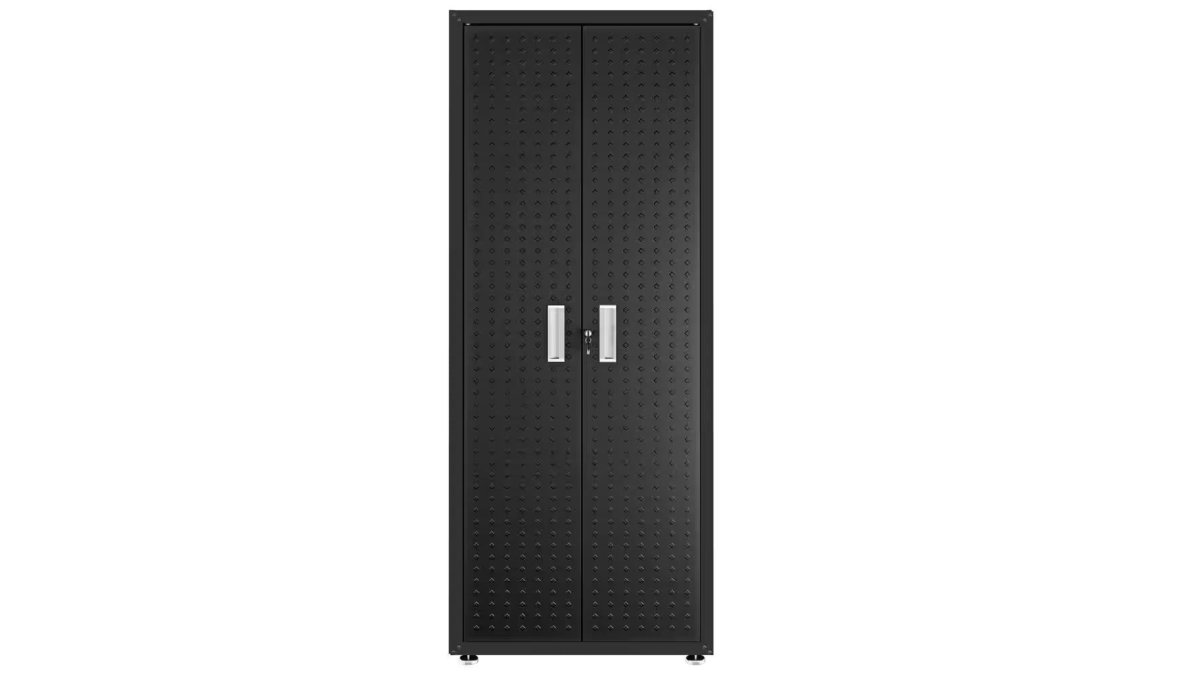
(/products/steel-garage-cabinet) is the lowest-priced freestanding pick here, and it does not feel cheap.
It meets or exceeds all ANSI/BIFMA standards, which matters if you run a small shop and need storage that survives daily use.
What most buyers miss is the shelf adjustment spacing. Two-inch increments let you tune shelf height to specific tool cases instead of wasting vertical gaps.
3. Ready-To-Assemble Gearbox: Best Mobile Workstation
The Ready-To-Assemble 3/4 Door Gearbox is the only cabinet here built to move. Its 28 x 31 x 18-inch steel frame holds up to 455 pounds per cabinet, with 55 pounds per shelf, and accepts casters to become a rolling workstation.
A full-extension drawer on ball-bearing slides handles hand tools without jamming, and the adjustable shelf reconfigures for paint supplies, automotive gear, or gardening equipment. Adjustable leveling legs compensate for uneven garage floors, a detail that matters in older concrete slabs.
It carries a 10-year limited warranty. For mechanics who work across multiple bays, this is the practical choice.
4. Fortress Wall-Mounted Series: Best Space-Saving Picks
Wall-mounted cabinets clear your floor entirely, and the Fortress series does it at the lowest entry price here: $169 for the single unit, $349 for the charcoal two-cabinet set, and $329 for the textured steel version.
Each cabinet measures 30 x 30.3 x 12.5 inches with double doors, one adjustable shelf, a door lock and key, and wall brackets included.
The trade-off is capacity: a 30-inch-wide wall cabinet holds less than a tall freestanding unit, so buy a set if your tool collection is large. For smaller items, hardware, and chemicals you want locked away, they are hard to beat.
5. Asti Wood Wall Mounted Cabinet: Best Moisture-Resistant Alternative
Steel is not the only answer in a damp garage. The Asti Wood Wall Mounted Cabinet uses eco-friendly E0-grade melamine boards with ABS edge banding twice as thick as standard, resisting moisture and everyday damage.

At 31.9 x 27.5 x 19.6 inches and $449, it is the priciest wall-mounted option here, earning that with a sleeker metallic gray finish and adjustable shelves with safety devices.
Are 18-Gauge Steel Garage Cabinets Worth the Investment?
Yes, for most garages. Steel gauge measures thickness, and lower numbers mean thicker metal. An 18-gauge cabinet resists the denting, warping, and shelf sag that thinner 22- or 24-gauge units develop under heavy loads.
The investment case rests on three things:
- Load capacity: Thicker steel holds more weight per shelf without bowing
- Durability: Powder-coated steel resists rust and tarnish in humid conditions
- Longevity: A cabinet that lasts a decade costs less per year than replacing a cheap unit twice
If you store light items and never load shelves heavily, a thinner cabinet may suffice. For heavy tools, parts, and hardware, 18-gauge steel pays for itself.
How to Organize a Garage with Heavy Duty Cabinets
Start by grouping items by weight and frequency of use, then assign the heaviest and least-used items to floor-level storage. Cabinets are only as good as the system inside them.
A workable sequence:
- Sort everything into keep, relocate, and discard piles
- Group keepers by category: hand tools, power tools, hardware, chemicals
- Place heavy items on low or fixed shelves, light items up high
- Use adjustable shelves to match shelf height to each tool case
- Label doors and drawers so items return to the same spot
- Reserve one drawer for fast-moving consumables like blades and fasteners
The goal is one home for every item. When a tool has a designated spot, cleanup takes minutes instead of an afternoon.
Garage Cabinet Weight Capacity Guide
Weight ratings are the most misunderstood spec in garage storage.
Here is how to read the numbers before you load a cabinet:
- Total cabinet capacity is the sum the manufacturer rates for the fully assembled unit under evenly distributed load. It assumes weight is spread across all shelves, not stacked in one corner.
- Per-shelf capacity is the real working limit. A cabinet rated at 455 pounds total may only rate each shelf at 55 pounds. Four shelves at 55 pounds each gets you to 220 pounds, well under the headline number.
- Drawer capacity is separate again. A full-extension drawer on ball-bearing slides is typically rated lower than a fixed shelf because the slides, not the steel, carry the load.
A common pattern in published specs: freestanding steel cabinets in the 30- to 36-inch width class land between 400 and 600 pounds total capacity, with per-shelf ratings in the 50- to 100-pound range.
A practical loading approach:
- Put the heaviest items on the bottom fixed shelf or the floor-level base, where the cabinet frame and floor share the load.
- Reserve adjustable shelves for mid-weight items like power tool cases and hardware bins.
- Keep top shelves for light, bulky items, paper goods, empty cases, seasonal supplies.
- Distribute weight across the full shelf width rather than clustering it near one upright.
- Re-check door alignment and shelf levelness after the first full load; if doors rub or shelves bow, redistribute before the deformation becomes permanent.
If your storage needs exceed what a single cabinet can safely hold, the better answer is a second cabinet or a heavier-gauge unit, not a creative loading strategy.
Best Garage Cabinet Installation Tips
Installation is where heavy-duty cabinets either earn their rating or quietly fail it.
Anchoring: what actually holds
- Wall studs are the only reliable anchor point for tall or wall-mounted cabinets. Use lag bolts or heavy-duty structural screws long enough to reach the stud's center, not drywall anchors.
- Drywall anchors are acceptable only for light wall-mounted cabinets under roughly 50 pounds total. Toggle bolts spread load better than plastic anchors but still rely on drywall, which fails under shock loads.
- Masonry walls (block or poured concrete) require sleeve anchors or wedge anchors sized to the cabinet's weight. Pre-drill to the anchor's specified diameter, oversized holes reduce holding strength.
- Freestanding cabinets should still be anchored. An unanchored tall cabinet can tip forward when a loaded door swings open or when a shelf is loaded unevenly. Most manufacturers include wall brackets for this reason; use them.
Tip-over prevention
Leveling on a sloped slab
Garage slabs typically slope 1/8 to 1/4 inch per foot toward the door, up to 5/8 inch of drop over a 30-inch cabinet.
Wall-mounted height and clearance
Mount wall cabinets so the bottom edge clears your tallest stored item plus door swing, and so doors do not collide with a vehicle hood or workbench backsplash.
Assembly order that saves effort
- Assemble the cabinet on the floor, on a moving blanket or cardboard, before lifting it.
- Locate and mark studs with a stud finder, then verify with a thin nail.
- Install the wall cleat or brackets first, then lift the cabinet into place with a second person.
- Level and shim before final tightening, anchors should not be used to pull a cabinet into level.
- Load the bottom shelves first and check door alignment as weight increases.
Most wall-mounted units hang in 20 to 30 minutes with basic tools, drill, level, stud finder, socket set. Freestanding tall cabinets take longer because of assembly, but the anchoring step is the same. The installation is not the hard part; skipping the anchoring is the mistake that turns a heavy-duty cabinet into a hazard.
Frequently Asked Questions
What gauge steel is best for heavy duty garage cabinets?
Lower gauge numbers mean thicker steel, and 18-gauge is the practical benchmark for heavy duty garage cabinets. It resists denting from dropped tools and holds shelf loads without bowing. Thinner 22 to 24-gauge steel is common in budget units and flexes under weight. Garage Mosaic builds its tool storage in 18-gauge steel, and the Ready-To-Assemble Gearbox is rated to hold up to 455 lbs per cabinet with 55 lbs per shelf.
How much weight can heavy duty garage cabinets hold?
It depends on the unit and the shelf. The Ready-To-Assemble 3/4 Door Gearbox is rated for 455 lbs per cabinet with 55 lbs per shelf. Freestanding cabinets generally carry more than wall-mounted ones because the floor bears the load, while wall cabinets rely on the bracket and wall structure. Always check the per-shelf rating rather than the total, since a single overloaded shelf is what causes most failures.
Are wall-mounted or floor-standing cabinets better for garages?
Wall-mounted cabinets free up floor space and keep tools off the ground, which suits smaller garages and anyone parking a vehicle inside. Floor-standing units carry more weight and suit bulky equipment. Many garages work best with both: a tall freestanding cabinet for heavy gear and wall-mounted units above a workbench. The Fortress wall-mounted cabinets include brackets and a lock, so they mount securely and stay locked.
How do I organize a garage with heavy duty cabinets without wasting space?
Start by measuring your available wall run and floor footprint before buying anything. Group items by weight: heavy tools and equipment go in freestanding base units, lighter and frequently used items go in wall-mounted cabinets at eye level. Adjustable shelves let you reconfigure as needs change. The Fortress 30.3 In. cabinet has three adjustable shelves and one fixed shelf, so you can set heights around what you actually store.
What should I look for when buying garage storage systems?
Prioritize steel thickness, verified load ratings, locking security, and adjustable shelving. Check the dimensions against your actual wall space, and confirm whether assembly is required. The Steel Garage Cabinet meets or exceeds ANSI/BIFMA standards and includes a 3-point locking system, while the Fortress wall-mounted units ship with wall brackets and a lock and key. Climate matters too: humid garages punish cheap finishes, so look for tarnish and moisture resistance.