

BendPak vs Atlas Auto Equipment: 2026 Comparison

Table of Contents
- Quick Comparison: BendPak vs Atlas Auto Equipment at a Glance
- Two-Post vs Four-Post: Which Configuration Fits Your Shop?
- ALI-Certified Car Lifts: What the Certification Actually Covers
- Car Lift Capacity and Safety: Matching the Lift to Your Vehicles
- Home Garage Car Lift Requirements: Slab, Ceiling, and Power
- Total Cost of Ownership: BendPak vs Atlas and Beyond
- Which Lift Should You Pick? A Decision Framework
- Conclusion
- Frequently Asked Questions
Last Updated: October 13, 2026
Quick Comparison: BendPak vs Atlas Auto Equipment at a Glance
Shopping for a car lift usually starts with a search for BendPak vs Atlas auto equipment, but the deeper question is what separates a certified lift from a bargain one. The Automotive Lift Institute's lift buyer's guide explains why certification matters more than brand name.
BendPak and Atlas both build lifts that work in the right setting, but what matters is whether the lift carries ALI certification, matches your vehicles' weight, and fits your slab, ceiling, and power supply.
| Factor | What to Check | Why It Decides the Purchase |
|---|---|---|
| Certification | ALI/ETL listing on the data plate | Proves third-party safety testing |
| Capacity | Load rating vs. heaviest vehicle | Underrated lifts fail under load |
| Configuration | Two-post, four-post, or mid-rise | Determines what jobs you can do |
| Installation | Slab thickness, ceiling height, voltage | Rules out lifts before price does |
| Ownership cost | Warranty, parts, maintenance | Long-term spend beats sticker price |
Two-Post vs Four-Post: Which Configuration Fits Your Shop?
Configuration decides more than brand. A two-post lift frees the wheels for brake, tire, and suspension work; a four-post lift gives you a stable runway for alignments, storage, and heavy trucks.

Two-post lifts use asymmetric or symmetric arm layouts. Asymmetric models suit low-profile sports cars because doors open clear of the arms; symmetric lifts handle full-size trucks and vans better because weight sits centered.
Our Krebs KB10 Two-Post Lift with 10,000lb Capacity covers the two-post side with a 10,000 lb load rating and adjustable arm reach. For storage and alignment work, the Krebs KB4 Four-Post Lift runs an 18-foot runway and the same 10,000 lb rating.

- Two-post: best for brake, tire, and suspension jobs
- Four-post: best for alignments, storage, and stacking
- Mid-rise: best for tight footprints and light trucks
ALI-Certified Car Lifts: What the Certification Actually Covers
ALI certification is a third-party safety verification, not a marketing badge.
What the certification actually covers:
- Structural load testing at rated capacity
- Safety lock engagement and holding power
- Hydraulic pressure relief and hose integrity
What it does not cover is your slab, anchor torque, or maintenance schedule, those are on you or your installer.
Every lift we stock meets the ANSI/ALCTV 2011 standard, including the Krebs Tell 6000 Mid-Rise Lift, a 6,000 lb mid-rise built for tire and brake work in tighter bays.

Car Lift Capacity and Safety: Matching the Lift to Your Vehicles
Capacity is not a suggestion. A lift's load rating must exceed your heaviest vehicle by more than a token margin. A 10,000 lb lift handles most half-ton trucks and SUVs; a 6,000 lb lift suits sedans and light trucks.
Safety locks are the second half of the equation. Certified lifts use mechanical locks that engage at set heights, backed by pressure relief valves and cable equalization so the platform stays level.
| Lift Type | Load Rating | Best For |
|---|---|---|
| Mid-rise | 6,000 lb | Sedans, tire and brake work |
| Two-post | 10,000 lb | Trucks, suspension, general repair |
| Four-post | 10,000 lb | Alignments, storage, heavy vehicles |
| Parking lift | 6,000 lb | Stacking two vehicles in one bay |
For collectors who need vertical storage rather than service access, the Krebs Quattro Park Four-Post Lift stacks four vehicles at 6,000 lb per level. The Krebs Duo Park Two-Post Parking Lift does the same job for two cars in a single bay.
Home Garage Car Lift Requirements: Slab, Ceiling, and Power
Home garage car lift requirements come down to three numbers: slab thickness, ceiling height, and voltage. Most two-post lifts need a reinforced concrete slab at least four inches thick and rated around 3,000 PSI, with anchors set per the installation manual. A four-post lift spreads load across a larger footprint, so it tolerates thinner slabs but still needs a level surface.
How to Test Your Slab Before You Buy
You cannot eyeball concrete thickness or strength. A four-inch slab that looks fine can be a three-inch slab with a weak mix, and no lift warranty covers an anchor pull-out. Here is how to verify what you have:
- Thickness: Drill a small test hole at the intended column locations with a masonry bit. Measure the depth with a bent wire or a depth gauge. If you hit gravel or dirt before four inches, stop, you need a pour or a different lift type.
- PSI: Concrete strength is not visible. A local lab can core-sample and report compressive strength for a modest fee. If you cannot test, assume 2,500 PSI unless you have the original pour ticket, and choose a lift that tolerates it or plan a reinforced pad.
- Cracks and level: Hairline shrinkage cracks are normal. Structural cracks wider than a credit card, spalling, or a slab sloping more than a quarter inch per ten feet are red flags. A four-post lift tolerates minor slope; a two-post cannot.
If your slab fails, you have three options: pour a reinforced pad at the column locations, switch to a four-post or mid-rise lift that spreads load, or choose a different bay.
Ceiling Height Math: A Simple Formula
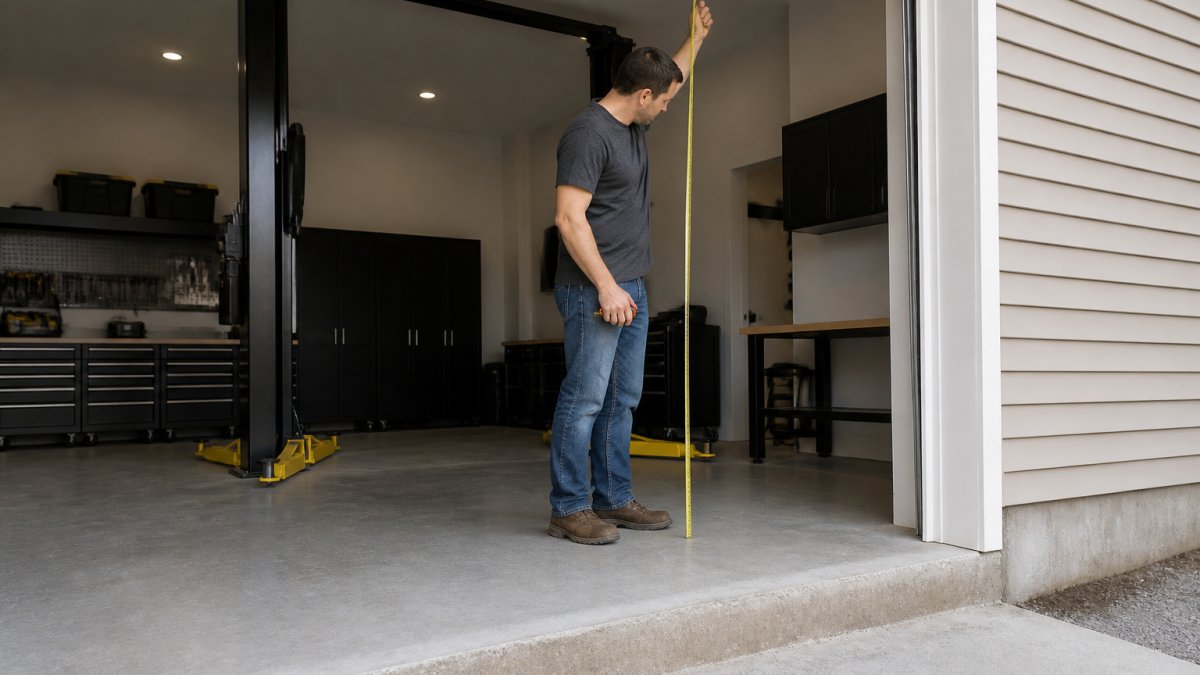
Ceiling height is the second gate and eliminates more buyers than price. Use this formula:
Raised lift height + tallest vehicle roof height + 6 inches of clearance = minimum ceiling height
The 6 inches covers safety lock engagement, overhead beams, garage door tracks, and the light fixture you forgot. Here is how it works with real numbers:
Krebs KB10 Two-Post Lift with 10,000lb Capacity – ALI Certified →
- A typical two-post lift raises to about 72 inches at the arm pads. A full-size truck roof sits around 78 inches. That is 150 inches, or 12 feet 6 inches, before clearance. A standard eight-foot ceiling (96 inches) cannot fit that combination.
- A mid-rise lift raises to roughly 48 inches. A sedan roof at 58 inches gives 106 inches, or just under nine feet. That fits many home garages.
- A four-post lift with a 70-inch raised height and a 60-inch sports car roof needs 136 inches, or 11 feet 4 inches.
Measure to the lowest obstruction, not the ceiling, garage door tracks, openers, and ducts are often lower. If you are within two inches of the limit, choose a lower-rise lift or a different vehicle position.
Power and Anchors: The Last Two Gates
Power is the third gate. Many full-size lifts run on 220V single-phase or three-phase power, so a standard 120V outlet will not carry them. Confirm your panel capacity and breaker space before delivery day.
Anchors are the fourth gate and are not optional. A two-post lift anchors into the slab with wedge or adhesive anchors torqued to the spec in the installation manual.
- Slab: 4 inches minimum, around 3,000 PSI, level and crack-free
- Ceiling: raised height plus vehicle roof plus 6 inches clearance
- Power: 220V circuit, correct phase, dedicated breaker
Total Cost of Ownership: BendPak vs Atlas and Beyond
Sticker price is the smallest number in this decision. Total cost of ownership includes the lift, freight, installation, anchors, electrical work, hydraulic fluid, and years of maintenance.
The BendPak vs Atlas auto equipment comparison usually stalls on purchase price, but the real spread shows up later. Structural warranty length, parts availability, and whether the manufacturer backs the hydraulic and electrical components all shift the math.
What a Real Installed Budget Looks Like
Most buyers budget for the lift and forget the rest. Here is the full line-item picture, using a typical 10,000 lb two-post lift as the example. These are common ranges, not quotes, your market and site conditions will move them.
- Lift purchase price: The largest line, and the one most buyers anchor on. A certified 10,000 lb two-post lift sits in a wide band depending on brand, features, and whether it is symmetric or asymmetric.
- Freight and unloading: Lifts ship on a flatbed or freight truck, so you need a forklift, a tractor with forks, or a crew. Residential delivery without a dock often carries a liftgate fee or a re-delivery fee if you are not ready.
- Installation labor: Professional installation is not required by every manufacturer, but many warranties require it. Two installers for a two-post lift is a common crew size; four-post and parking lifts take longer.
The Hidden Costs That Separate a Cheap Lift from a Good One
Two lifts with the same load rating can have very different five-year costs. Watch for these:
- Parts availability: A lift from a brand with no US parts network can sit broken for weeks waiting on a hydraulic cylinder or safety lock. Certified lifts from established makers have published parts diagrams and stocked wear items.
- Warranty terms: Read what is actually covered. A "lifetime" warranty covering only the frame and excluding hydraulics, electrical, and labor is not the same as a five-year structural warranty with a clear parts path.
- Hydraulic oil type: Some lifts specify a particular oil or additive. If it is hard to source, every service costs more.
Resale Value and Market Liquidity
Where a lift holds its value matters too. Certified lifts from established makers resell faster because buyers can verify the certification and find parts. Off-brand lifts sit on the market longer, eroding the savings you thought you captured.
If you might move or upgrade your shop, think about the lift as an asset, not a consumable. The brands that hold value have a certification number a buyer can look up and a parts catalog that still exists.
Which Lift Should You Pick? A Decision Framework
Use this framework to choose between BendPak vs Atlas auto equipment and every other option on the market. Work through the questions in order; the first one that eliminates a lift is usually the right one.
- Does the lift carry ALI certification with a data plate?
- Does the load rating exceed your heaviest loaded vehicle?
- Does the configuration match your main job (service, alignment, or storage)?
If a lift fails the certification or slab question, stop there. Those two gates eliminate more candidates than price ever will. If it clears all eight, the brand question becomes a tiebreaker rather than a deal-breaker.
Conclusion
The hardest part of buying a lift is not choosing a brand; it is confirming that your slab, ceiling, and power supply can carry the lift you want. Garage Mosaic stocks ALI-certified car lifts built for exactly that decision, including two-post and four-post models with 10,000 lb capacity, mid-rise lifts for tight bays, and parking lifts that stack vehicles vertically.
Frequently Asked Questions
Are BendPak and Atlas car lifts ALI certified?
ALI certification is the benchmark to check on any lift you're considering. The Automotive Lift Institute tests lifts against ANSI/ALCTV standards for structural integrity, safety locks, and load holding. Both BendPak and Atlas offer certified models, but certification is model-specific, not brand-wide. Always confirm the exact model you're buying carries the ALI gold label. Garage Mosaic's Krebs lifts, including the KB10 two-post and KB4 four-post, are ALI certified to ANSI ALCTV 2011.
What garage requirements should I check before installing a two-post lift?
Start with your concrete slab: most two-post lifts need a minimum of 4 inches of 3,000 PSI reinforced concrete, though some models specify thicker slabs. Measure your ceiling height against the lift's raised height plus the tallest vehicle you'll service. Check your power supply, since many full-rise lifts run on 220V. Finally, confirm the lift's overall width fits your bay with room to open car doors. Getting these four numbers right before ordering saves costly returns.
How do I choose the right lift capacity for my vehicles?
Add up the heaviest vehicle you plan to lift, then add a safety margin of at least 20 percent. A 10,000 lb lift comfortably handles full-size trucks and SUVs, while a 6,000 lb lift suits sedans and light trucks. Check the individual axle weights too, not just the total, because a lift's arms must support each end. If you service a mix of vehicles, size for the heaviest one you'll see regularly rather than buying twice.
Why do some car lifts cost so much more than others?
Price differences usually come down to steel gauge, welding quality, hydraulic components, and certification. Lifts built with precision robotic welding, reinforced crossbeams, and double-baked powder coat finishes cost more upfront but resist corrosion and wear for years. Certified models also carry the cost of independent testing. A cheaper lift that fails inspection or needs replacement in three years often costs more than a professional-grade unit bought once.
What should I compare when choosing between BendPak and Atlas lifts?
Compare four things: certification status for the specific model, lifting capacity against your heaviest vehicle, installation requirements including slab thickness and ceiling height, and warranty coverage. Also look at the locking system, hydraulic control type, and whether the lift supports both symmetric and asymmetric loading. A side-by-side spec sheet beats brand reputation every time, because the right lift depends on your garage, not the logo on the column.